How is it going? I have taken a little time off as the past month has been a little hectic with other things taking priority but we are back at it again!
When trying to learn anything knew, it is important to take it in steps. We can't assume to learn everything in one sitting. How much time can you dedicate to one thing before you need to stop? That depends on every session. I like to view my mind as a sponge; if I try to put way to much information in a small setting, it won't be able to absorb all that is presented to me. Instead, if I take small steps along the way, I can retain a lot more information so that it stays with me for the next time.
This is a pretty good representation of how I feel when I can't retain anything else.
A good example of this was when I learned the phrase, "I don't care" in Mandarin. Instead of brushing it aside and learning more things, I took it upon myself to use it multiple times in a conversation. This really helped me to remember how to say it and when to use it. I made sure to keep myself from getting overwhelmed with information.
This past month I started meeting with new students at the University of Maryland. This situation usually causes my sponge to overflow with information. I met two weeks in a row which caused two different reactions for me. The first week I was stressed out and had a lot on my mind. While I tried to talk as best I could, nothing really was "sticking" and I could hardly understand a sentence that was said to me. The second week I came at it with a different approach, was more structured, and even challenged myself by not falling back to English and had a more positive result.
Some notes from one of my previous meetings. No English was allowed.
I like the idea of not falling back. This causes you to learn what is being said with no direct translation. When discussing how I struggle to read handwritten characters, I learned the phrase for short hand characters without any English explanation. This means that my whole understanding of the phrase is directly in Mandarin. Now, I have no way of falling back to English because I never learned it that way.
Here is a quick video recapping what I've done the past few weeks. The time it takes to add the subtitles right now is more effort than it is worth. Instead, here is a summary of what I talk about: A few weeks ago I built a new computer, last week I volunteered, and today I want to ride my bike. It is too hot outside so I should drink a lot of water. I thought building a computer was very hard but now I think everyone can do it. Later, I have to buy food and wash my clothes. Yesterday I went running.
So if you know me quite well, you are not surprised to know that I have a dog. He is wonderful. I make to let everybody know.
Why am I mentioning this? When I go about learning words, I learn the words that apply to me. I need to know phrases that I will likely use because......I plan to use them. Being as I don't have a cat, the need to talk about cats isn't as high on my priority. This is likely why you hear me mention "kelbi" nearly every video, because that is "my dog".
Look at how tired they are though! You may not know this, but I really like my dog.
I learned very quickly how to say "engineer" not because it is an easy word to say, but because I need to be able to say it. This means I learn it much sooner than would typically be taught, but I also will be using it more than the average learner would.
Hesitated in writing the translations in Arabic and instead just used the phonetic versions.
Anyways, I'll keep this short. I started writing out some sentences and seeing how well I could translate them before having to look up words and I was pleasantly surprised. I've gotten very good in the past few weeks at saying "to swim" (which coincidentally is how long I have been swimming again).
When I first began learning Chinese, I signed up for a class. There are a lot of reasons to sign up for a class; you may not know where to start, you may want a structured outline of where to go, you may want to have friends that you can study with. Overall, everybody will have their own reasons, but mine was mainly to confirm that the pronunciation that I was doing was correct. I had been studying Chinese for over three months and I wasn't sure if my tones were actually correct.
After the class, I grew the confidence to have my first real conversation and start really practicing. I believed I could converse with natives and wasn't as nervous about the situation (granted I was still VERY nervous)
Recently, my teacher invited me to attend a private lesson with some of his other students. I was excited as this likely would be both a new opportunity to learn, and a way to refresh and show him the progress that I've made. Attending the class was a wonderful experience for me. It wasn't due to the learning that I achieved during the class, but instead the opportunity to see how much I have improved since his class.
I quickly saw that most of the phrases and vocabulary that I use now were taught to me through real life conversations, not while attending a class. My confidence to speak was far greater than I realized while watching others in the class speak. Not only that, I noticed that my pronunciation was much closer to the style that the native speakers do than the other classmates.
I can't begin to praise how effective actually speaking with people did for me. When I first began learning how to speak Chinese, I would have to sit and rehearse fake conversations with myself in hopes that I would have the courage to actually go and initiate one someday. Now, I don't hesitate for that opportunity because I know the joy that it brings both myself for being able to speak, and them for having somebody willing to talk to them.
Anyways, here's a short video randomly talking about my weekend.
A few weeks ago, I mentioned how as of recently, other things had taken priority in my life. I wanted to learn Arabic, but not as much as I was willing to give up other things. I told myself to change this habit and to focus a little time on Arabic every day. These small time frames could be anywhere from five minutes a day to an hour, but the key was to do it EVERY DAY.
Most of the time, these efforts were utilized in a common setting: staring at a notebook and reviewing vocabulary. The parts that were more beneficial were the uncommon settings. Allowing myself to review, speak, practice, etc. in a more natural state allowed me to associate speaking in every day settings. Here are some of those moments:
Talking to myself in the car.
Having conversations with myself at the grocery store.
Translating conversations while in the middle of them.
Explaining all the steps of getting food to eating it, while trying to cook it.
Posting small phrases on language learning websites to be corrected.
While exercising.
Conversing via WhatsApp
The big thing is to keep going. Sure, I feel like I've had more success as of late but if I pause I could lose all the progress that I've made. The longer I wait between reviewing the harder it is to remember. Making sure to take a small amount every day, no matter how small, can help to keep that comfort and confidence where it is at right now.
Here is a video of me trying to utilize some of the phrases I worked on this week. Making all my videos on the first take definitely leaves the sentences sounding choppy, but with repetition after the videos I can become more flowing with all that I say.
So I haven't been as adamant about posting in the past few months. Like most people, I'm very quick to chalk it up by being busy with other things in my life. Over the past few months I've looked at multiple ways to incorporate self-improvement. By doing this, it has quickly filled up my schedule to the point that I don't have time to do certain things. Sadly, practicing languages is one of those things that took the hit.
I find this all extremely ironic because I really strive to NOT be busy. My goal is to always allow myself time to keep from overwhelming myself. I value the idea that I typically allow some free time each day to do whatever peaks my interests at the time. Every time that I see something regarding learning Arabic I get envious. I wish I could be able to communicate using it. The problem is that I can easily get wrapped up in the social media platforms (likely one that brought you here) and suddenly the time has been lost. I try to find those small pieces of time throughout the day to practice, but I also need to make sure I dedicate a good focused effort to really make progress. It just can get difficult when you are so busy.
I'm going to change my vocabulary; instead of saying that I'm busy, I will say, it isn't a priority to me. That's because it is true. We like to tell ourselves that we will find time to do things, but there really isn't secret time hidden throughout the day. Instead, we prioritize certain things to take up the 24 hours of our day. I've seen various things take up those hours, but each time I decide what will be a priority. As of late, studying languages has not been a priority for me. I don't really like the sound of that.
Think of the goals, activities, plans, etc. that you would like to incorporate into your life and instead of saying, "I'm just too busy to <activity>" replace it with, "<activity> is not a priority to me" and see how it feels. Exercising and staying healthy is not a priority to me. Staying in contact with a friend who has moved away is not a priority to me. Learning to cook healthy meals is not a priority to me. They don't sound as good than saying you're too busy do they? These are only a few examples, but you can hopefully see the point I'm making; we all have time to do what we want in our day but you have to be willing to sacrifice other things that can eat up your time (watching TV, browsing social media, etc.).
Time to get back on track with this. I really am going to think about making sure I dedicate a little time every day, no matter how long, to review and learn. Sure there may be days that I miss, those days may have something that I have to prioritize higher on my list. The goal is still progress, not perfection. I am happy to currently be on a two day streak of reviewing so let's see if I can keep this up!
As I've gone about chatting with people using my languages, I continually mess up with regards to the grammar. Grammar is easily the portion of learning languages that causes the most struggle for me. As much as you would think vocabulary would be a big limiter, it usually isn't. Even if I don't know an exact word I can explain and describe it to a point that my conversation partner can figure out the missing word. For me, being able to structure a sentence correctly to make sense is a bigger struggle; do you put the adjective before or after the noun?
In all reality, it doesn't matter too much. If somebody said, "I ate a big meal." or "I ate a meal big." I would understand them either way. The main point is to speak the words because the more you use the language, the better you will become as speaking it and more comfortable overall.
When other language learners try to speak with me in English and mess up just a tad, I still understand them. I'm never frustrated with them for saying something wrong. I shouldn't be so hard on myself when it comes to the grammar. Every time I say something incorrectly, I feel embarrassed and want to apologize and yet on the other side, I never feel as though they should feel that way.
Last week I was chatting with one of my friends on a call and we started discussing how my Arabic was progressing. She, an Iraqi, was actually able to relate to some of the struggles that I have with learning the language. As I've mentioned many a times, the dialects can be very different from various locations. It was reassuring to learn that even other Arabic speakers struggle with different dialects. I learned when a Moroccan dialect is being spoken on TV there are Arabic subtitles provided to help understand them. They literally have subtitles of the same language that is being spoken. Knowing that native speakers struggle with the dialects was a very wonderful thing to hear.
Anyways, here is a short little bit of me talking about whatever comes to mind. It may not be factually accurate but instead I'm hoping to say a few things with no real plan of what I say. Let's see what happens!
So the past few weeks have been all over the place. Sadly, I wasn't able to post for a few weeks, but I'm back today!
As I've been working with language partners, sometimes the conversations get repetitive or redundant. You can only talk about what you did today for so long before you realize you do the same things quite a bit. This can limit your excitement about conversing if you aren't sure where to go.
When I first started chatting, it helped to have an outline because it allowed you a certain vocabulary to stay within when trying to have a conversation. It helps to make you more comfortable when you only have to talk about one topic to help prepare. These topics can be useful as they are pretty general that you can do a few times without repeating:
Weather
Hobbies
Food
Introduce a family member/friend
While this helps at the beginning, later on it isn't as necessary. Your vocabulary can expand so that you can talk about more daily routines without much difficulty, but what about when you want to do more? How can you encourage yourself to continue to grow and have unique conversations. This is my next goal of expanding conversations beyond just formalities about the week. Here are some easy conversation topics that are still easy to discuss but can help generate a more interesting conversation than just "What did you do today?"
Tell a story from when you were younger
Give a synopsis of your favorite movie
If you could travel anywhere in the world, where would you go and why?
What is your biggest pet peeve?
These are a little more advanced than just, "Today, it was raining," but help to create a more meaningful conversation. Next week, I plan to tell my friend, Jing, about how I was my high school mascot for three years. I'm guessing that it will create A LOT of questions and a conversation we haven't really had.
This week I prepare for a chat talking about the weather in Arabic. We will see how this goes!
Last week I got excited as I felt like I was making more progress with being able to ask for a specific dialect. To make sure I kept up that momentum, I took to the language learning programs that I've used to make sure I find people who are willing to work with me using the correct dialect. I took some time and prepared a few phrases to send to people. My hopes was that I would get a few who were willing to respond. That escalated quickly.
I spent a good 10-15 minutes writing that up.... and then I go and get these responses!
I forgot that when you message somebody in a specific language, they believe you can speak that language. Instantly, the level of responses I got back was much higher than I was ready for. This required me to quickly establish myself and try to converse with everything that I had. I'm happy to say that it went better than I originally thought.
Today, I was able to have two different conversations in Arabic with two different people. Both lasted for just short of 20 minutes including about half of it in Arabic. I was happy to learn new words that I will likely become more accustomed to using. My goals were to be able to be understood and to recognize at least one portion that I wasn't expecting. Looking back on both, I was successful!
More than anything, these conversations were a great way to see if what I'm doing is right. They were able to understand what I was saying, would recognize when I needed help, and were more than happy to clarify things that caused questions for me. I'm hoping that they continue into a more consistent language exchange.
Being as I didn't get to record either of the chats, I get to freestyle for a little today. We will see what I come up with. Seriously, I think I mention that I like playing with my dog, Ryan, EVERY week......
So in a previous post I mentioned how Mandarin is actually, in my opinion, not as hard as many people make it out to be. There are some differences than English, but some of those differences can actually be easier depending on how you approach the difference. I've mentioned before that Arabic has been more difficult for me and there are definitely some things that I've done to also increase that challenge.
One of those ideas is to try to spend a small amount of money on learning this language. This was intended to show that you don't need to spend a lot of money to learn a language, you just need the right resources. By limiting the costs, I've limited some of the resources I could use such as professional teaching. This required a lot of guessing and hoping without true direction from the start.
Another issue I had was trying to learn a specific dialect. The typical way people learn Arabic is through "Modern Standard" Arabic which nobody actually speaks. This is taught first because it is the foundation you can build off of for other dialects but to be able to speak, you need to learn a dialect. Trying to speak "Shakespeare-ian" is as close of an analogy to the experience you would have trying to speak Modern Standard to a native. Instead, dialects are more the path you need to take, but which one? At first I didn't know but after reflection I finally settled on the Levantine dialect which is most commonly used in the Middle East countries as opposed to Egyptian Arabic which is actually the most popular but used mainly in Egypt and mainstream media. By choosing Levantine, this required me to be sure I was learning the correct words, so I need to filter through all Modern Standard, Egyptian, Moroccan, Levantine, and all lesser used dialects to be sure I'm learning the material I want. This at times can be confusing.
"Kwayis" "Jayid" "Mniih" are three different ways of saying, "I'm good"......not very similar.
This past week, I was able to find a new resource called Forvo which has recordings of people from different regions saying different translations. This is perfect for me as it shows a map and I can quickly determine if they are using the same dialect and relevant vocabulary for me. I'm really happy with this new resource.
Reviewing what I learned in my lessons I took at the end of last year, I need to focus on incorporating more verb tenses into what I say.
Last week I started one of my goals to read 20 books for the entire year. I felt it was appropriate for me to read a book about language learning so I tried out, "Fluent Forever" by Gabriel Wyner. I won't go into much detail about my opinion of the book but instead will focus on one part that I've really embraced.
A common trend that all learners are adapting to is the SRS (spaced repetition system). This idea is that as you review things more often it will allow you to go longer without having to study it again. This is a common way to transfer short term memory into long term memory. Basically the goal is to bring something back up to review right as you are about to forget it. This allows you to only study things that are absolutely necessary to be more efficient. There are multiple programs that utilize this system which I have used before but this previous week I began making my own flash cards. Instead of using a pre-made deck of cards, I have to go and find the words that I want to learn. This also is allowing me to better understand what each word means to me. This has allowed me to completely remove English from the flash cards and have them entirely in another language.
What does this card mean? Unless you made it (or can read Arabic) it likely won't have the intended meaning.
Not only has this helped me with the spelling, but it has made the experience more fun. Now, I get to choose which picture best represents "sleep" for me instead of just trying to associate the spelling alone. The last few days I have been much more excited to do my flashcards than previously before. I think having fun is important for this. You can't go after a goal if you don't enjoy what you're doing. After a while, that initial excitement will wear off and then you are left with whether you "want" to do something.
A good example for this is my weekly Skype chats I have with my friend, Jing. Being able to discuss things in Mandarin has always been exciting for me. When I first started I was terrified and sat with a long list of vocab words that I needed to use. Now, I'm much more comfortable and just talk about anything that comes to mind. This week I'm including a short 2 minute recording of our chat we had this morning where I talked about what I did over the holiday break. I apologize for the quality of the audio/video combo. Testing out new ways of doing things. Enjoy!
Back when I started, I set a few goals of what I wanted to accomplish this year. Here is a look back on those goals and which I accomplished:
Have a 15 minute conversation using ONLY Chinese
Be able to speak a 5 minute monologue in Chinese
Have a 40 minute conversation using ONLY Chinese
Having a 15 minute conversation with somebody who DOESN'T speak any English
Watch an episode of a Chinese TV show and be able to understand what is happening
Be able to read and pronounce a full page of Arabic whether I know the words or not
Have a 30 minute conversation with somebody that is a mix of Arabic/English
Listen to an Arabic song and be able to explain it in Chinese
Yikes, 4/8 is not too high of a number to be proud of. As the year progressed I learned a lot about what was realistic to ask of myself for these languages. There were times I didn't study as much as I should have but there was also times I studied more than I planned. Had everything gone perfect I feel I could have gotten around 6 or 7 of those goals completed this year, but I'm not perfect nor do I strive to be.
I try not to look at the failures that have happened. Instead, I strive to look at the successes that came about. Here are a few things that I was able to do that was not intended:
Reconnect with old friends who have since started to learn languages as well.
Get in contact with language learners from Europe who are also learning the same languages as me.
Have my blog posted on an international language learning website.
Have a conversation about something that I've never prepared for in another language.
Meet some people from countries that I was learning their language.
Have foreigners trying to help me plan my trip to China.
Now's the time to look forward to 2017. With the new year I'm supposed to make new goals right? I'm not going to be adding any new languages but instead just trying to develop the languages I've started.
Be able to have a 15 minute conversation in three different foreign languages for 15 minutes each (Mandarin, Arabic, and Spanish) without any English
Write an entire blog post without using English (sorry)
Find somebody that I can set up a weekly chat with to have an Arabic/English exchange
Find somebody that wants to learn one of these languages that I can help teach
I'm sure I'll create some more specific goals along the way. Main one is number 4, if you or anybody you know is interested in learning Spanish, Mandarin, or Arabic I would be happy to join them on that journey (I can offer the most tips in Mandarin of the three). For now, here is a video of all three at once!
So one of the best things I've learned throughout my language learning is the difference in holiday traditions. Due to the time of year, I felt I should share a little bit about that.
One main difference is when countries celebrate the "new year". In America, we celebrate it between December and January, but in a lot of other countries they celebrate at a different time. The Chinese New Year is a really big holiday that causes a lot of workers to get at least a week off. Some people can get up to two weeks off for this day which they will travel home and spend with their families. This is pretty common to what we celebrate here as well.
My friend, Jing, was able to send me some photos from Tianjin.
Two different traditions they do involve cleaning out their houses. This is done as a way to remove any "bad spirits" that may reside from the previous year in hopes of starting the new year with only good spirits. There is also decorations that are put up. This isn't so much the way that we do to celebrate but instead to scare away. The decorations are meant to scare away any new spirits or ghosts that may be in the streets coming to bring bad times to your family.
Strawberries for Christmas!
Before you judge, remember that we are the people who grow up learning not to stop on cracks in the sidewalk for our mother's safety. We are worried of "jinxing" ourselves and believe the best way to rid ourselves of this is to find the nearest wood and knock on it......okay.
Most recently, I was talking to a few people about how Christmas is celebrated. As Christmas has turned into more of a holiday for buying gifts, it is partially treated that way in China. It isn't celebrated as a traditional holiday, more of a "Hallmark Holiday." The unique part is more around Christmas Eve. In China, this is celebrated by giving people apples, the fruit. It is common to give somebody an apple as a way of wishing them well on Christmas Eve. Sure, this seems truly strange as apple prices rise with the demand and they can even cost extra if they are pre-wrapped, but there is an extremely simple explanation for all of this. In Mandarin, Christmas Eve is 平安夜 (Píng'ān yè) which has the word for apple in it as well (苹果Píngguǒ). Basically, they use the name to determine what to do with it.
Apples at the office for all the employees.
For all my friends learning Mandarin, I wish an apple on you and your family today. To the rest of you, I wish you a happy holiday season, whichever you celebrate. We all celebrate our holidays differently, but what they all center around is family.
Yes, you read that right. I seriously just understood what I'm saying. It came to me yesterday as I was going for a run. My mind tends to wander a lot which leads to a common, "How did you think of that?" response from people when I tell them. Regardless, somehow while I was running I was just thinking about Arabic. Over the last few weeks I have been gaining a better understanding of the language including different possessive words.
مع السلامة
Go with peace (Good bye)
السلام عليكم
Peace be upon your day (Hello)
وعليكم السلام
And your day with peace (Hello response)
It may seem silly to see this written out but in Mandarin it is actually a more awkward saying. Most people are familiar with how to say hello in Mandarin but do they really understand what is being said? More importantly, when you ask how somebody is doing:
你好
You good (Hello)
你好吗
You good, yes? (How are you?)
Mainly, asking how somebody is in Mandarin can almost appear awkward. We have these types of phrases in English as well. Our typical greeting can range from, "What's up?" which likely would confuse any foreigner if that was the first question you asked them, or, "How are you doing?" How am I doing what? How am I doing in life?! Geez, the most awkward part about these questions is that when somebody asks you this, if you answer anything beyond, "I'm good." You'll get a bad response. Somehow, it is now part of our culture that we ask how we are doing but don't actually care to hear a real response.
Looking at how my Arabic has grown over the past month, I can definitely see some growth in what I can say. I may struggle at times to come up with the correct word, conjugation, tense, etc. but I know that I can say more than what I previously had done. Before, I was reciting things that I had memorized; now I am creating new sentences by combining words that I've learned and grammar that I've acquired. This has caused my speaking to slow down, but that is what I want to emphasize. I want to show the moments when I'm thinking on my feet. I don't want to prepare a nice memorized script to read to you because that doesn't really show how I would interact in a social setting.
My biggest weakness right now is my listening. I plan to attack that this week so hopefully I can have a better idea of how to actually listen to the language that I'm speaking.
So I mentioned previously that I was having a tough way of going about this. My initial plan wasn't working as well as I had hoped and my confidence was draining. There needed to be some direction in what I was doing. You can't exactly get to a final destination if you don't have a map.
I decided a few weeks ago to get some tutoring. It wasn't going to be too intensive, just help get a foundation that I could build on. My hope was that after a few lessons I would be able to start applying what I learned into expanding my skills.
I was able to find a "community tutor" who was able to work with me from Palestine and immediately I could tell a difference. The first thing we did was go over verb conjugations, which hadn't been explained to me yet, and suddenly I took off. Although I was struggling to get words out as effectively, I was happier knowing that what I was doing was actually correct. Previously, I was only memorizing phrases, but now I can manipulate a sentence to mean something different with just a few words.
So many notes to write in Arabic, in English, to listen, to say, bah! Gotta keep up!
The lessons have been difficult at times. Being as they are only an hour we try to jam as much information into that hour as possible, which usually leaves me overwhelmed by the end. Also, due to the time differences, the lessons are all at 5am. This has left me exceptionally exhausted at times but if I want to make this work, I have to make it a priority. It isn't just when it is convenient that I practice; I need to make time for this and put forth the effort.
One thing really struck me during my last lesson which was Friday morning. Whenever I am presented a new work, I am given both the English phonetic spelling as well as the Arabic spelling. With newer words that are being presented to me, I have been able to write them out in Arabic BEFORE I am even given the spelling. This was exciting knowing that I am starting to differentiate certain letters that sound similar. This was a small but happy win in the Alex column.
We're making progress guys! On day at a time.
I have one more lesson in a week before I have to decide to sign up for more lessons or to go back on my own. At this time I'm not sure which way I will go. Both ways have their benefits so I'm hoping after the lesson I will have a better idea of which I want to pursue. For now, I'll leave you with another Arabic video!
Accidentally used the wrong verbs when talking about my dog, so pretend I am talking TO him, about him, and it totally works.......
This goes out to anybody taking on something new. That can be anybody taking on a new language like myself, a change in your nutrition, a change in your exercise routine, etc. At some point we all decide to make a change in hopes for the better. That initial moment is exciting, you have a purpose and a plan and you're ready to go!
How long has it been? How long since you started? How long since it wasn't as easy to stay motivated? How long since you felt you like you were still doing it right?
The truth is, that initial moment is going to pass and following it will be a large place of uncertainty. When I first began learning Arabic I was excited. I felt like I was learning things and moving forward. After a few days I hit that first bump in the road and it slowed me down. Suddenly, things started to get more difficult. My motivation from before was still trying to push back but the obstacles got larger. Did I take a wrong turn? Why wasn't it as easy as before?
Honestly, that rut hit me for longer than I want to admit. I felt like I had a vague idea of the language for a while. I felt I could recognize the letters, but other than that all I could do was say, "Hello." This can really start to wear down on you.
Whenever we set out with a new goal, a new change, a new plan, etc. we always have the end in sight but we forget about the middle ground. We forget how difficult those times in between can be. So what happens when we get to those difficult times? We lose our path. We forget why we started. That's the time to really remember why we started.
For anybody who is striving for something more but struggling through the middle, take a second to remind yourself of why you started and where you hope to get to. You'd be surprised how often we forget to encourage ourselves to keep pushing for our own goals.
One thing that is important to do is to remind yourself of how far you've come. I can look at my video I made today and say, "Wow, I struggled to get out a single sentence. I had to stop and think for EVERY word." I could continually tell myself that I'm no where near being able to comfortable talk with people without a cheat sheet. Or, I can look at how far I've come. Most of the words and phrases I'm saying I didn't even know two weeks ago. This week I could actually say some phrases that explain myself and my family. Even though I look confused and lost in the videos I've posted the past two weeks, I am a lot more confident in myself and what I'm doing.
Stay positive and keep pushing yourself to reach your goals. We'll get through the rough patches together. Please feel free to contact me if you need any motivation for chasing your goals.
I'm excited to announce I've made some real Arabic progress! This past week I was able to work with somebody from the Middle East to help get a better understanding of how to approach the language. So far I have learned more in the past week than I felt I have in nearly five months of studying.
For starters, I now have a better understanding of verbs. Verbs start with a root word that can be expanded out to form different words for each person. This has helped A LOT as I can then take any verb and hopefully format it to work with any word I want. This helped in realizing how you say, "How are you?"
Last week I was able to distinguish between "my book" and "this book". During the past week I have been able to expand on that and learn more ways of saying possession of a noun. This has been a really good starting block for a lot more to come.
Having an understanding of the alphabet has helped quite a bit. This was especially helpful when new words were presented and I was able to help distinguish between a few letters that may sound the same but look different. I've been able to write out most of the stuff that I've learned.
Look at all the things I can write!
I'm quite happy with this past week. Although a lot of the stuff I have learned is more shaky than what I have been learning, I feel that it is pushing me in the correct direction. I feel that I have a better foundation to build off of with what I've been learning over the past week. My hope is that this confidence can help keep me both motivated and pushing myself every day from here forward.
Overall this week's post is short. There's a lot going on behind the scenes that has me optimistic. This week my video is literally going to be me just rehearsing phrases and words that I've learned most recently. It likely won't make sense but I hope you can feel more confidence being shown, maybe not from the presentation of what I say but in the fearlessness that what I'm saying is closer to correct.
When I first began learning Chinese, I told myself it was because I wanted to meet new people. The idea was that I would be able to communicate with people who I previously hadn't been able to communicate with due to a language barrier. For a year I felt like I was doing that until I realized that everybody I was communicating with was also learning English. This meant that although I was able to use a new language to talk to them, I still would have been able to had I tried speaking English. I needed a different idea.
At the same time I was getting frustrated. Most of the people I tried to talk with had the same mindset as me. You come to a language learning app, with the hopes of being able to practice your language with a native. Most people didn't want to dedicate their time speaking their native language helping the other person. This often led to a "language battle" where each person only responds using the language they're learning, so it isn't really a conversation of either language. I tried to play the middle ground and respond in both languages, but the person I was talking to wouldn't budge.
Finally, I made a rash decision: I was going to find somebody else who would only speak to me in Chinese. How was I going to do this? I set out to find somebody who was ALSO learning Chinese, but from a different country. My goal was that they couldn't speak English so that the only language we could communicate with was Chinese. Initially, I messaged people in Chinese with my plan, but due to how complex of an idea it was, I didn't get any responses. Most people thought I was way beyond their level or didn't feel they could communicate with somebody in Chinese.
I went to my second attempt. Knowing that they couldn't translate as much as I was sending in Chinese, I needed to message them in their language. The problem was I didn't know their language at all. How did I accomplish this? Google translate is a wonderful thing! I typed up a generic message in English, translated it to various languages, and then sent it to people from those countries. Most people were terrified of this idea, fearing that without a comfortable language for us both to communicate in, how would we talk if we got lost in translation? Some people have responded and it has been entertaining to say the least.
Carrying on a conversation with somebody who is also learning Chinese can get interesting.
My success rate of getting somebody to respond is way below 10%. Some people respond back in their language (thanks Google for helping to translate that), some respond in English, but most responses come in Chinese. This sets up a beneficial situation for both of us as we can focus on the one language we both want to learn.
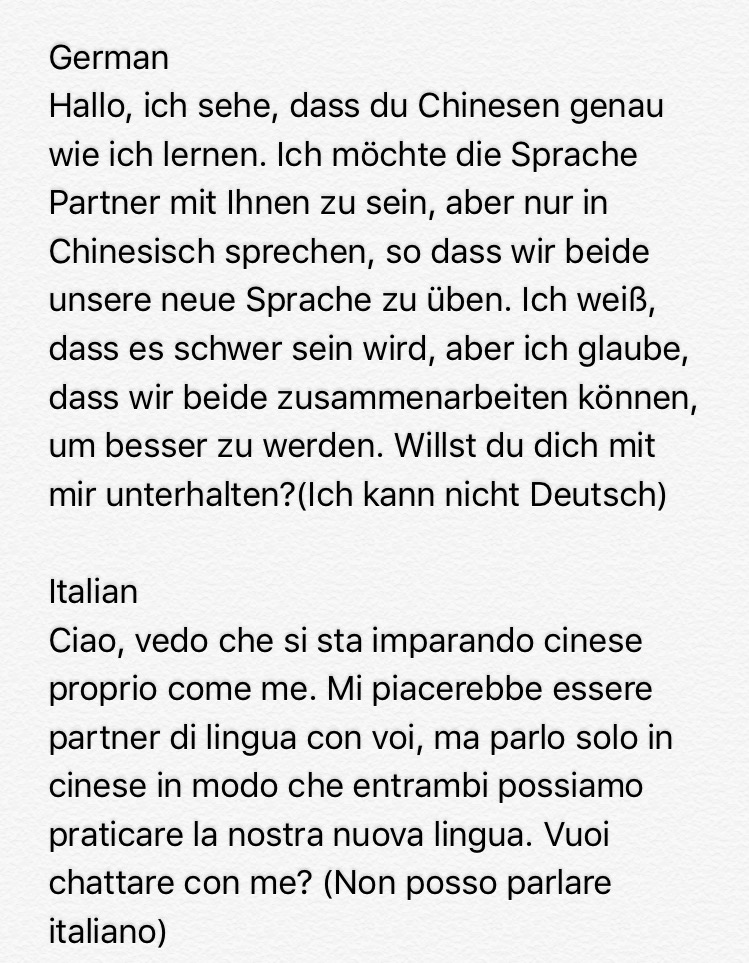
A few of the translations I've used to try to get people to talk to me.
This summer I had the chance to have an actual video chat with somebody from a different country. I was terrified. To prepare, I sent them a list of vocabulary words that I would likely use to introduce myself (I don't expect a beginner to know Mechanical Engineer) to help make sure we could keep a conversation going. Not only that, but knowing that some words may be confusing, I drew pictures. I figured if they got confused when I said I like to ride bikes, I could draw a bicycle and hopefully we could communicate that way. The person I was supposed to chat with got scared and passed the video off to their friend who also spoke Chinese. Being as determined as I was, I was still able to have a conversation with them even though we didn't really have time to prepare. My drawings didn't have to come up either.
Overall, the experience of trying to meet somebody that doesn't speak English at all has been entertaining. There is plenty of times people ignore my request, but there's also times that I can have an actual conversation with somebody that I never would have been able to before. Currenlty, I am having conversations with two different people from different countries in Africa who are also learning Chinese. Had I never reached out to those people, I never would have been able to talk to them. Better to take a chance than to never have that opportunity, right?
This week I had a wonderful little breakthrough. I had been realizing that sometimes you should say "al" before a noun but never figured out why. Turns out it is a way of saying "the" or "a". This week I was able to help understand the difference between that and saying "my". Little steps lead to a lot bigger progress.
I'm not the only person learning a language. There are millions of people learning other languages. I've talked to multiple people who are also learning a language at this time; so what makes me different? Do I have a secret to allow me to be better at learning a language? Yes, it is using the language.
This seems so obvious but it can be challenging as well. Obviously as we learn a language our hope is to be able to use it. The issue is that we always wait until we think we are "good enough" to actually start to use it. We'll wait until we have a large enough vocabulary, grammar, confidence, etc. The problem is that this is actually slowing down the progress.
Nobody was able to walk on their first attempt. The first word you ever said when you were a baby likely wasn't some novel idea. The first time you do something, you aren't going to be good at it. The sooner you get working on it the sooner it will be able to improve. You can spend hours, days, and years reading how to ride a bike but until you get out and start riding you won't see that improvement.
More than anything, you have to be willing to make mistakes. Don't be worried about saying something incorrectly. You'll find that people get excited when you are speaking their language and will go out of their way to help you instead. Not only that, but you learn more from your mistakes than from your successes. I figured out pretty quick the different between "don't" and "haven't" with regards to Mandarin. If you recall, the first time I tried to tell somebody that we were hungry because we "haven't" eat I accidentally said we "don't". That's a pretty big difference in those regards and the reaction I got proved that as well. The more willing you are to throw yourself out there and make mistakes, the more likely you are to see improvement.
Friday night Jessie and I watched The Chronicles of Narnia and I thought it'd be fun to try to translate it in real time as we went. It wasn't long before I was asked to stop but it was cool to see that I was able to translate quite a bit more than I expected. I've done this before with a Dr. Seuss book and the same reaction happened. I was more successful than I thought I would have been. Sometimes you have to stop holding yourself back and just trust that you can do more than you thought.
This week I did a lot of planning for future improvements that I'm hoping to see in about a month. I realized I had some goals earlier in the year that I may not have completed so I'm going to try to see which ones are still within reach without going off my main path just to check off a box. This week I went for my 5 minute monologue in Chinese. I used it as a way to talk about a challenge that I've faced when trying to practice Chinese.
Not even going to try adding subtitles for all of this. My video editing system right now is lacking to say the least. Instead, fun activity for anybody who speaks Mandarin to use it as a chance to listen. Again, I made plenty of mistakes along the way. There's words I don't have in my vocabulary, word order was off, I couldn't think of what to say, etc. but the important thing is that I can give it my full effort and not back down.
Literally thought to myself, "Why am I always sitting in the same seat?" so I stepped outside. Guys, I went outside!
When I first began learning a language, I had no intent of really learning the culture behind it. I figured everything would be pretty straight forward and equivalent to English. Obviously, that isn't the case. As you learn a language, there is certain indications about the culture itself that you have to learn to really interact.
My first experience of this was when I began learning the appropriate way to start a conversation with somebody using Chinese. A common phrase, "你好吗?" is closely related to, "How are you?" There was a time that hunger was a very serious issue in China. This issue led so much that a common greeting was instead inquiring that the person you were talking to had eaten for the day. Previously, a more common phrase to use was, "你吃了吗?" which is, "Have you eaten yet?" If somebody approached me on the street in the U.S. and asked me that out of no where, I'd likely be a little skeptical; are you about to ask me out to eat? This common phrase from the older generations in China is a way of showing your concern for the well-being of somebody you are talking to.
Another interesting aspect of other languages is the order of your name. In China, your name is commonly referred to as <Last Name> <First Name>. I always like to consider the values of the country when looking at this situation. When it comes down to who you are, you put your family first.
In a more grammatical sense, the explanation is likely that it is common to start with a larger group and then go to a smaller subsection. Instead of saying, "I am from Iowa City, Iowa, U.S." I would say, "I am from U.S., Iowa, Iowa City" For a lot of people I'm sure this seems completely backwards, why would I say something that way? Honestly, it makes more sense to start with the general area. You may not know where Iowa City or Iowa is located so until I mention the U.S. you are completely clueless as to where I am talking. On the other hand, when I start with the general area you are more clear of the location prior to hearing the exact place.
With regards to Arabic, there is a lot of religion that goes with the phrases. Here is a list of common phrases and their literal translations:
Hello (Peace be upon you) السلام عليكم
Hello (Peace upon you as well) وعليكم السلام
Response to how are you: (Good, praise to Allah) كويس الحمد لله
Response to offering you to do something: (If Allah wills it) إن شاء الله
At first this may seem to concern people, the whole language is driven by religion!? What about English? We always say things like, "Bless your" or "God bless you" and it never is a very big deal. When tragedy strikes a certain person or location, we say, "Pray for <blank>". There are certain words that originated from religion as well. "Holiday" can easily be rooted back to "Holy Day" yet we use "Happy Holidays" as a way to refrain from any religious conflicts.
Overall, one theme that can be seen in a lot of languages is how you pay respect to your family. It took me a little time when I first began Chinese to realize that having a brother wasn't good enough. There are different words for siblings that are either older or younger than you. There are different words for you dad's and your mom's parents. This is seen in a lot of other languages as well, distinguishing somebody by either their age or their side of the family.
Another interesting aspect of languages is how some of them are related. Would you believe that one of the easiest languages is actually rooted from one of the hardest? Due to historical conquests, there are around 8,000 Spanish words that have Arabic origin. This week I am going to go over some of those words in both Spanish and Arabic to show how nearly 600 years of separating cultures can still have very similar sounds.I will start each one with the Spanish word, followed by the original Arabic word.
About a month ago I was getting very frustrated with my
Arabic progress. I didn’t feel like I was getting better, I couldn’t figure out
how to form sentences, I wasn’t confident in what dialect to use, and I just
overall didn’t like the way things were going. About the only thing I had going
for me was that I could recognize almost all the letters in all their forms. In
all honesty, I wanted to learn, I just didn’t know how. I feel that Arabic is one of the most beautiful languages to listen to and I wanted to be
able to understand what I was listening to; I just couldn’t figure out how to go about progressing.
A lot of times when I get frustrated with Arabic I start to
doubt myself. Maybe Arabic is just too hard for me to learn by myself? I have
considered giving up countless times and just focusing on Mandarin. I have a
good thing going with Mandarin; why not focus on that and come back to Arabic
in a few years?Mandarin is more fun
because I can use it. Most situations that come up in my day, I can talk about
in some way or another.
Recently, I found a school in China that I could attend that
is a full immersion school. This would allow me to improve my Mandarin while
living in the country, using it to explore, learn, grow, etc. But is this what
I want? Do I want to spend money to be taught how to use a language or do I
want to make mistakes and learn from personal experiences? I’ve started to plan
a 10-14-day trip where I would travel through China, visiting the people that
I’ve met while learning this language and seeing their cities. Sure, this
school would be easier to coordinate the experience, but would I be able to
make it my own? For now, I’m putting it on a back burner. One thing that has kept me going is this blog. I can't just give up on something so quickly, what would I really be proving with that? At times I feel embarrassed that I'm struggling because I wanted to be able to show everyone that anybody can learn a language. What instead I'm hoping this shows is that, yes, it is hard, you will have bad days, you will doubt yourself, you will think of giving up, but you are not alone. I hope this will show you that even with any success I've had it hasn't been an easy path. I hope you realize that if you are trying to do the same thing and feel confused, I've been there as well. I can tell you from experience that it does get better, it does get easier, and it does get a lot more fun once you can really start to use a language. So thank you for taking the time to read this. Knowing that wherever you are, you are watching what I'm doing, has given me motivation to not give up and to help keep this journey going. I couldn't do it without you. This week has given me some optimism. I’ve finally started
learning more of a dialect than the Modern Standard Arabic (MSA) because nobody
speaks using MSA. I found some videos that go through some simple phrases in
Egyptian Arabic and have started to repeat those phrases to myself more and
more each day. I’m feeling better that I can say those without too much
trouble. Not only have I started to focus on a few videos, I also watched a few
other people speaking Arabic and I recognized more than I thought I would. I
figured I would catch the first two sentences and that would be it, but I could
follow for almost a minute! Even more exciting for me was trying to pick up random words
further into the dialogue. Sometimes when taking on a new challenge the easiest
part may not be at the beginning. This could be why, using my triathlon experience,
you learn to ride a bicycle before you attempt a flying mount. When learning a
new song, you might start at a portion in the middle of the song that is
simpler than just the beginning. For languages, you can’t always start with the
first word and begin learning that word before moving further on. I was so
excited while listening to somebody speak Arabic when suddenly I recognized the
word for “film” which I hadn’t practiced for a month or so. Sure, I didn’t
catch the whole sentence but by knowing a few words within a sentence you can
piece together the meaning of the whole.
When you have two hours between flights, you be productive!
This weekend I’m going to be busy with a wedding (Congrats
to Cameron and Kylie!) so I won’t be able to dedicate as much time to my blog
which is why I’m currently writing it in an airport. My video is going to be
reflecting on as many phrases and words that I can remember in all dialects of
Arabic that I’ve learned (MSA, Egyptian, Iraqi). When we don’t take the time to
reflect on our progress, it can quickly seem like we haven’t made any progress.
I hope that this video will do more good for myself than for you in reminding
me of how far I’ve come.